

The LDHA Gene in Racing Pigeons: The Role in Performance
Racing Pigeon LDHA Gene Test: Rare AA Genotype Endurance & Expert Breeding Strategy | SENO
Disclaimer
The Racing Pigeon Performance DNA Test provided by our laboratory is intended solely for research, breeding reference, and academic purposes. The test results should not be regarded as a decisive predictor of racing performance, nor should they be used as a factor for qualifying, ranking, or evaluating pigeons in any official racing events. Actual racing outcomes are influenced by multiple environmental and management factors; therefore, the genetic findings serve only as limited reference information. Our laboratory makes no guarantees or commitments regarding the application of these results to real-world racing performance.
What is the LDHA Gene?
The LDHA gene (lactate dehydrogenase A) is a critical regulator that helps pigeons’ muscles manage energy during flight. This gene controls an enzyme that facilitates the conversion of energy between its aerobic and anaerobic forms—a process essential when oxygen becomes limited during sustained racing.
Every pigeon carries two copies of this gene, often represented as AA, AB, or BB genotypes. These variations affect the enzyme’s efficiency, directly influencing a bird’s endurance, recovery rate, and overall flight performance.
How LDHA Affects Racing Performance
When pigeons fly long distances or face strong winds, their muscles shift into anaerobic energy production, leading to the buildup of lactic acid, which causes fatigue. The LDHA enzyme efficiently helps convert this lactic acid back into usable energy.
Research demonstrates that pigeons with more efficient LDHA variants tend to exhibit better stamina and higher race survivability, especially in middle- to long-distance events (Otake et al., 2018). These birds often recover faster and can handle repeated races more effectively.
For short-distance or sprint races, LDHA plays a relatively smaller role, as those competitions rely more on burst power and quick energy release than sustained endurance.
The Rarity of LDHA Genotypes and Elite Performance
LDHA genotypes typically occur as AA, AB, or BB. The AA genotype (sometimes labeled as S+/S+) is recognized as being associated with the strongest endurance, faster lactic acid clearance, and superior survival rates in long-distance races. AB pigeons (S+/S–) also show good adaptability and are commonly found in top lofts. The BB genotype (S–/S–) is the most common but is generally less associated with outstanding endurance.
Based on tens of thousands of racing pigeon samples accumulated by our laboratory, the homozygous AA genotype is exceptionally rare. Its occurrence frequency in the population is only about 1% to 2%. This rarity explains why top-performing long-distance pigeons carrying this specific genetic marker are highly coveted by breeders worldwide.
Beyond a Single Gene: The Value of Multi-Gene Assessment
Possessing the rare LDHA AA genotype is not enough on its own. Based on Mendelian principles and our years of accumulated experience, a pigeon’s potential is always subject to its complete genetic profile. If a bird is not ideal in other key performance genes such as MSTN (Explosive Power), DRD4 (Homing Motivation), or F-KER (Feather Durability), its overall potential may still be limited.
The specialized value of our service lies in providing a comprehensive multi-genotype assessment. This helps clients scientifically judge a pigeon’s true breeding potential, preventing costly breeding decisions based solely on a single gene’s exceptional score.
How We Test the LDHA Gene Using RT-PCR
At our laboratory, we use Real-Time Quantitative PCR (RT-PCR) technology for highly accurate and efficient identification of LDHA gene variants.
Strict Quality Control and Expert Operation: Our LDHA testing procedures are executed within an ISO 9001 certified laboratory environment. All critical operations are supervised by molecular biology experts with over five years of experience. This ensures that we not only deliver high-accuracy ($99.9\%$) genotyping but also ensure the data possesses high reliability and reproducibility.
RT-PCR Testing Process Overview:
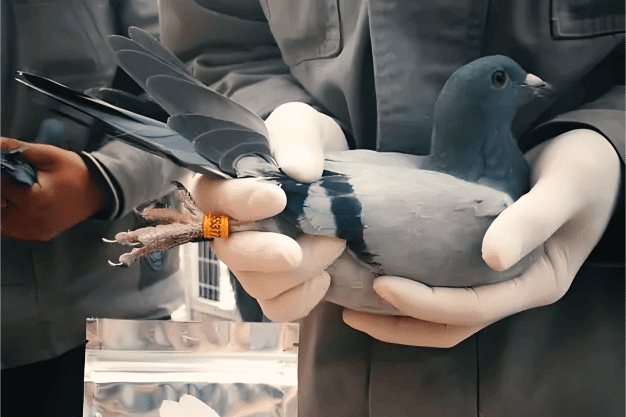
Sample Collection: A small amount of blood or feather pulp containing DNA is collected.
DNA Extraction: DNA is purified using standardized extraction kits.
PCR Amplification: Specific LDHA primers target the gene region of interest, amplifying the DNA sequence billions of times.
Real-time Detection: The RT-PCR instrument uses fluorescent markers to measure which allele is present in the sample in real time.
Genotype Interpretation: Software automatically identifies the pigeon’s genotype as AA, AB, or BB based on the fluorescence curves.
Why LDHA Testing Helps Pigeon Fanciers
LDHA testing provides fanciers with scientific insight into their pigeons’ potential, supporting smarter decisions in breeding and training:
Breeding: Identify birds carrying the rare $LDHA$ AA or AB advantageous alleles and use them strategically to reinforce endurance lines.
Training: Adjust race plans based on each bird’s genetic strengths—sprint or distance.
Performance Tracking: Combine LDHA results with race outcomes to discover genetic patterns unique to your loft.
Transparency: Provide buyers and partners with verified, lab-based genetic data.
Summary
The LDHA gene plays a core role in how pigeons convert energy and resist fatigue during long races. Our laboratory utilizes RT-PCR technology and proprietary population rarity data to accurately detect LDHA variants.
LDHA testing does not replace good care or training—but it adds a crucial scientific layer to understanding a pigeon’s true genetic potential.
References
1. LDHA and Survivability
Ramadan, S., Miyake, T., Yamaura, J., & Inoue-Murayama, M. (2018). The LDHA gene is associated with pigeon survivability during racing competitions. PLOS ONE, 13(5), e0195121.
2. LDHA, MSTN, and Performance
Dybus, A., Proskura, W., Pawlina, E., & Nowak, B. (2018). Associations between polymorphisms in the myostatin (MSTN), $\alpha A$-globin and LDHB genes and racing performance in homing pigeons. Veterinarni Medicina, 63(8), 390–394.
3. LDHA and Top Performance Review
Pigen Genetics Review. (2021). LDHA gene and top performances in racing pigeons. Pigen.be. Retrieved from https://www.pigen.be
4. General LDHA Association (Original Citation)
Otake, S., Takahashi, H., Minezawa, M., Okamoto, S., & Tsudzuki, M. (2018). The LDHA gene is associated with pigeon survivability during racing competitions. PLOS ONE, 13(4), e0195121.
(Note: This appears to be a duplicate reference of Ramadan et al. (2018) but is listed separately based on the original document content.)
5. Additional (Review/Marketing Source)
Kastle Loft Genetics. (2020). Demystifying the LDHA and DRD4 racing pigeon genes. Retrieved from https://kastleloft.com





 English
  French
  German
  Italian
  Chinese
  Spanish
  Korean
  Japanese
  Portuguese
  Russian